When “Solving” Nature’s Job Becomes Humanity’s Burden
In Hanyuan County, Sichuan Province — proudly self-titled the “world’s pear capital” — spring no longer hums with the sound of bees. Instead, it echoes with something stranger: farmers climbing ladders into blossoming trees, bamboo sticks in hand, painstakingly transferring pollen from flower to flower themselves. This is not a quaint tradition. It is the direct consequence of a decision made decades ago in the name of efficiency — and it has quietly become one of modern agriculture’s most telling cautionary tales.
From Rice Paddies to Pear Orchards: A Profitable Gamble
The story begins in the 1980s, when China’s Home Responsibility System gave farmers new freedom to farm for profit rather than quota. In Hanyuan’s mountainous terrain, farmers found that pears sold for several times the price of rice, and land once used for paddies was rapidly converted into commercial pear orchards. It was, on paper, a rational economic choice — better terrain use, higher returns, and a booming market to sell into.
But scaling up fruit production came with a hidden cost. To protect their now-valuable pear crops from pests and disease, farmers began applying pesticides more heavily and more frequently than ever before.
The Pesticide Trade-Off Nobody Priced In
Pesticides did what they were designed to do — they killed pests. But they didn’t stop there. Wild bee populations in the region collapsed under the sustained chemical exposure, and local beekeepers, unwilling to risk their hives in heavily sprayed orchards, began relocating their colonies elsewhere. Within a relatively short span, Hanyuan’s pear trees lost their natural pollinators entirely.
This is where the story stops being a simple pest-control decision and becomes something larger: a demonstration of how short-term efficiency gains can create long-term structural costs. The bees had been performing pollination for free, as a byproduct of a functioning ecosystem. Once that ecosystem service disappeared, it didn’t simply vanish from the balance sheet — it reappeared as a new, permanent labor expense.
Hand Pollination: Rebuilding by Hand What Nature Once Did for Free
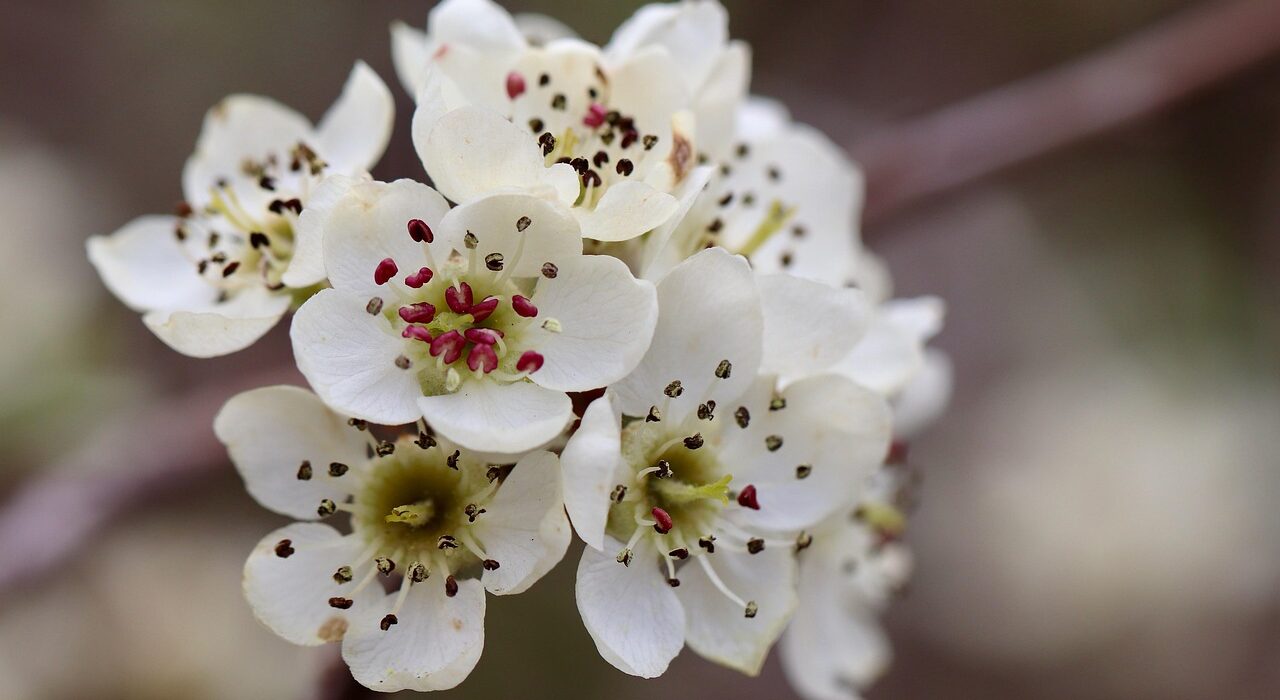
With no bees left, Hanyuan’s farmers had no choice but to become pollinators themselves. Each spring, entire families take part in a labor-intensive ritual: collecting pollen from healthy blossoms, drying it, and then applying it flower by flower using simple homemade tools — often a bamboo stick tipped with chicken feathers, sometimes a small brush.
The work is slow, physically demanding, and unglamorous. Unlike a bee, which can visit dozens of blossoms a minute, a human pollinator might need most of a day to cover a single tree. Every flower must be reached individually, and workers often balance on ladders or climb into the branches themselves to do it. Multiply that across entire orchards covering an agricultural county, and hand pollination becomes not a quirky workaround but a massive, recurring seasonal labor operation involving thousands of people.
The Real Cost of a “Solved” Problem
This is the crux of Hanyuan’s story, and why it resonates well beyond agriculture. Pesticides were adopted to solve a narrow problem — pest damage — in pursuit of higher yields and greater profit. They succeeded at that narrow task. But they also eliminated an unpriced, invisible service that the entire system quietly depended on. When that service disappeared, humanity didn’t get to walk away — it had to reinvent the wheel, by hand, at a fraction of the efficiency and a much higher ongoing cost.
It’s a pattern worth recognizing, because it isn’t unique to pear orchards. Modern civilization repeatedly optimizes for a single visible metric — yield, speed, convenience, cost-per-unit — while treating the systems that support that metric as free and infinite. When those systems break down, the fix is rarely as elegant as the original problem. It’s slower, costlier, and far more labor-intensive than the natural process it replaces.
Is Hand Pollination Sustainable?
Increasingly, the answer looks like no. Rising labor costs, an aging rural workforce, and a younger generation more interested in city jobs than orchard work are all putting pressure on the practice. Fruit yields from hand pollination are also reportedly declining compared to what natural pollination once achieved. Hanyuan’s farmers are, in effect, running to stand still — pouring in more labor each year simply to maintain what bees used to provide passively.
The Bigger Lesson From China’s Pear Capital
Hanyuan County’s bee-less orchards are more than a curious photo essay subject. They are a small, human-scale monument to a much larger pattern in modern development: the tendency to solve one problem out of a desire for more — more yield, more profit, more control — only to end up spending far more later to undo the damage. The bees didn’t send an invoice while they were alive. Now that they’re gone, the bill has come due, one blossom at a time.
Sources:
- Editorial Photographers UK — Mariann Fercsik, “Hand Pollination in China,” citing research by Professor Tang-Ya, Chengdu University
- Bee Culture, “Pollination In China” (2021)
- Wikipedia, “Hand-pollination,” entry on Hanyuan County pear cultivation
- The Weather Channel, “Photographer Captures Bee-less Dystopia in China” (2016)
- FoodUnfolded, “Pollinating Orchards By Hand: Lessons From Sichuan, China” (2022)